

Planning
Students’ report
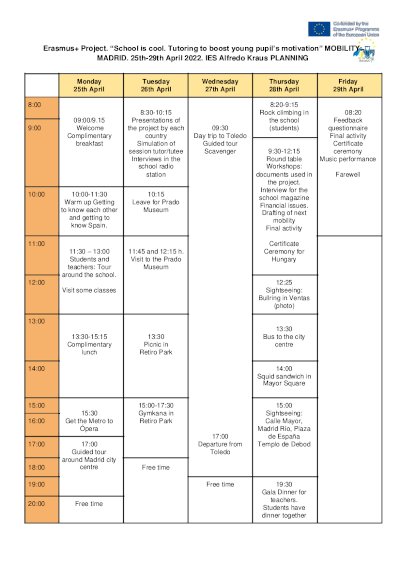
We arrived in Spain in the afternoon of Sunday 24 th of April, and we met the students from Spain the following day. They immediately made us feel comfortable and answered all of our questions. We felt welcomed and we immediately connected and talked with them about their culture and ours and the differences between them.
The mobility was organized by the Spanish school, we were able to see many different places in Madrid, such as the Royal Palace, Museo del Prado, Gran Via, Retiro Park and many other interesting little spots thanks to the amazing guide that led our city tour. One day we also visited the small but very characteristic city of Toledo.
In the mornings we experienced different activities at school, which enabled to better understand how education works there, and we have to say it’s pretty different from ours. For example, relationships between teachers and students are much more intimate than ours, they have a different dress code and exams work a little differently: they have semesters and they take the final exams at the end of them, it is not like in Italy where we have tests and exams at the end of each topic in all the different subjects. Thanks to this works at school, we were also able to talk about how the different countries dealt with the organization of the tutoring programme, which was very interesting and formative and led us to think about which aspects of the Italian organization of the project could be changed to make the tutoring more effective, but also about which were our strengths. On Thursday at school, we spoke about how each country dealt with the continuation of the project after Covid, and it was useful to see what all of us could have done better.
Generally speaking, we have to say that the Spanish culture is very similar to the Italian one, so it was not hard to connect with the students, indeed we established amazing relations with them, but we were also able to connect with the students of the other nationalities going over the walls of differences that there were between our very different cultures. Indeed, on the last day, we had a very moving moment when everybody had a piece of paper stuck on their backs and we could write what we thought about each other on them, everybody was super nice and we understood that we had found some great new friends. Some of us are, actually, still in contact with other students from Spain, Hungary and Belgium; the use of technology in this case is on our side, because it allows us to always keep in contact, almost as if we were always together even if we are kilometers apart.
As per our group, we were immediately able to get on well together and to establish a good relationship, both among us and with the teachers, which is something that allowed us to experience a great trip, having fun while also taking the educational journey seriously.
There were of course some critical points in the organization, but it must be taken into account when you have to go around cities and do activities with a large number of teenagers, so even if there were some dead moments while working at school and we were often a little late on the schedule, we can say that everything always worked out the best it could and we had so much fun.
To conclude, we are very happy to have met so many incredible people, and seeing young students with big dreams that represent our future was very inspiring.
The students from the Italian group
Teachers’ report
Erasmus KA 02- Mobility to Madrid April 25 th – 29 th 2022
Our Spanish experience started with a warm welcome: one teacher and some Spanish students were waiting for us at the bus stop in front of the “Metropolitan Wanda” Stadium, then they accompanied all the groups (from Italy, Hungary and Belgium) to their school Alfredo Kraus. On the way to school, both students and teachers started to create a good relationship.
When we arrived, we realized that a party had been organized for our arrival. A delicious breakfast with churros and hot chocolate contributed to create the proper atmosphere to meet and know each other. All the Spanish teachers, as well as the headmaster, were there to explain to us the plan for our week together. After that, we were divided into two mixed groups and we were led around the school by the Spanish teachers. The school includes both Middle and High School. After a complete visit of the school, each teacher was invited to attend a lesson of his/her subject, or similar.
For example, Mrs Molinari attended a Contemporary History lesson: she was invited to talk to the students about the 70s in Italy, in English, meanwhile the Spanish teacher explained the events of same period occurred in Spain, supported by some slides. Many questions stimulating historical reasoning were asked. On the other hand, Mrs Graffeo attended a part of a Philosophy lesson held by an Italian teacher who has been living and teaching in Madrid for some years now. After that, she had the possibility to be present during a test of Economics; the test was a kind of preparation for the following week’s examination.
Finally, Mrs Minniti was invited to take part to a Debate lesson: the students were guided in learning how to intervene in a debate using English as vehicular language, expressing there opinions and giving reasons for those. This experience was really useful for new ideas and practices in our lessons.
Teachers and students from all the countries involved in the project had a convivial lunch together, during which everyone communicated using the English language. The typical dishes offered were a good opportunity to better know Spanish food culture.
In the afternoon we went on a tour around the citycentre with an English speaking local guide; we were able to appreciate the architecture of the city and its history (such as old shops, the Royal Palace, the Cathedral, the Opera theater, the covered fish market).
The following morning teachers and students separated; students gathered in a big classroom where they worked in groups and where they later showed the teachers all the different steps of the tutoring project, together with the point of weakness and strength of the relationship between tutors and tutees in the different countries involved.
Another aggregative activity took place at the Prado Museum: here the students were asked to split in mixed groups, and afterwards they were accompanied by Spanish teachers on already planned mini tours around the museum. During the visit the students were invited to listen to the explanation of the different pictures previously recorded by Spanish students.
Following to the visit at the Prado Museum we had a picnic at the Retiro Park, where both students and teachers ate a sandwich together enjoying nature. This was again an aggregating activity.
After lunch, still in the park, there was a treasure hunt in small groups, which allowed everybody to explore the monuments and typical areas in the park. As usual, the groups were composed by students and teachers of different countries, to encourage socialization and the use of the English language. On Wednesday we went and visit Toledo: the visit offered everybody a full immersion in Spanish history, with its Jewish districts and the main square, which allowed us to enjoy the city rich architecture and orography.
When we were at school, the teachers compared their different ways to organize and manage the projects in their own schools, highlighting different aspects, as follows: Spain promoted it on their school website using descriptions and pictures, while Hungary carried out the activities in order to try and make their students happier during school time, also planning specific after school activities.
As Spain did, they also promoted the project with pictures.
Later on, Belgium introduced a draft plan of the mobility in their country.
After this meeting, the teachers reached the students in the main room for the delivery of the attendance certificates to Hungarians.
We all went to the old citycentre with the underground to spend a whole afternoon there altogether; we visited Plaza Mayor and Debod Temple. In the evening two different dinners were planned, one for the teachers and one for the students. The time spent together allowed all of us to implement socializing good practice.